Who Were the Buffalo Soldiers
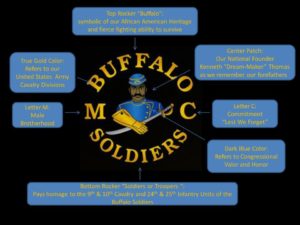
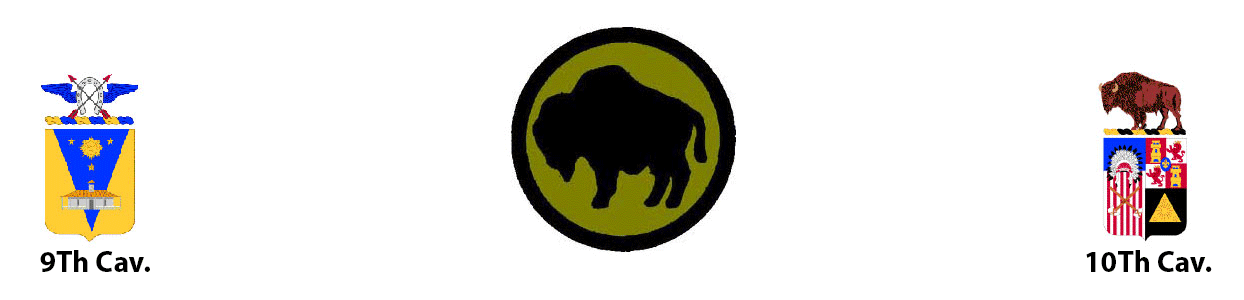
In 1866 the United States Congress authorized six segregated army regiments, the 9th and 10th cavalries and the 38th, 39th, 40th, and 41st infantries. The Buffalo Soldiers were African American soldiers who joined the army for food and pay. Their era lasted from 1866 to 1948. They fought in many wars including, The Indian Wars, The Spanish-American War, the Philippine-American War, World War One, and World War Two. The Indian tribes Cheyenne, Apache, and Cherokee were believed to have given the Buffalo Soldiers their name. They thought that their hair looked and felt like the mane between a buffalo’s horns. They respected the buffalo because the buffalo was a very important part of their lives, and they respected the Buffalo Soldiers as fierce and brave fighters. Even though the name “Buffalo Soldier” was given as a compliment, they rarely used the name as a tag for themselves.
Their Triumph and Tradgey
In 1861 Frederick Douglass said, “Once let a black man get upon his person the brass letters U. S., let him get an eagle on his button and a musket on his shoulder and bullets in his pocket there is no power on earth which can deny that he has earned the right to citizenship in the United States.” This was a “code of honor” that future Buffalo Soldiers followed. They proved this point by being brave, loyal, and fearless in battle. But they did everything they could to end segregation and racism.
The Buffalo Soldiers helped greatly in the settling of the west. During the Indian Wars they fought many Native American leaders such as Nana, Victorio, Geronimo, and Sitting Bull. But most of their time of duty was peacetime. In the Spanish-American War they played an important part at the Battle of San Juan Hill. They came to the aid of Theodore Roosevelt and his Rough Riders. They stormed the hill, not retreating. Although they suffered many losses, they captured the hill. It was a great triumph because the Buffalo Soldiers were on foot and Roosevelt and His Rough Riders were on horses. Roosevelt publicly praised the effort of the Buffalo Soldiers after the war.
Roosevelt would later do something that devastated many Buffalo Soldiers. After 167 black soldiers in the 25th infantry were positioned at Fort Brown, in Brownsville Texas the citizens were furious. Shots were fired on the night of August 13. Mysterious attackers moved through the town firing leaving a bartender dead and a policeman seriously wounded. The citizens of Brownsville blamed the Buffalo Soldiers using evidence that was later found to be false. 12 members of the 25th were jailed. Later the soldiers were assembled and asked to step forward if they had participated in the riots, and not one did. Also when they were asked to speak out against their fellow soldiers, not one of the 25th did. Because of this alleged “lack of participation” all 167 of the 25th, not just the original 12 arrested were given “dishonorable” discharges. Roosevelt waited until after the election to sign the discharges. All of the soldiers’ back pay and pensions were taken away. This is an example of the institutional racism the Buffalo Soldiers faced.
In 1942 James Thompson wrote a letter to the Pittsburgh Courier wanting to start a campaign to raise awareness about segregation in World War II. It was called the Double V campaign. The “Double V” meant “Victory at Home and Victory Abroad.” So the Courier launched a public campaign. It worked, and on July 26, 1948, President Harry S. Truman signed Executive Order 9981 officially ending the practice of segregated army regiments and the Buffalo Soldiers. But the Tragedy of racism still continued. In 1972 President Nixon publicly stated that the Buffalo Soldiers at Fort Brown were falsely accused, and granted their back pay and pensions to them. But only one of the 167 Buffalo Soldiers was alive. The Buffalo Soldiers monument at Fort Lavenworth Texas wasn’t constructed until 1992. Colonel Charles Young, a Buffalo soldier who served in the 19th and 20th centuries, finally honored by a Senate resolution in 2001, 80 years after his death. The Tuskegee Airmen were not Buffalo Soldiers; they were a segregated Air Force unit. They received the Congressional Gold Medal from President Bush on Friday, March 30, 2007- 76 years later. This shows that the Buffalo Soldiers and all of the African Americans who served their country endured racism not only by their fellow soldiers but by society as well. The Tragedy was that most of them thought that by serving their country bravely and fearlessly that they could end racism, but racism still persisted.